Mazafati Rotab Dates: What Rotab Means and How to Buy Them Fresh
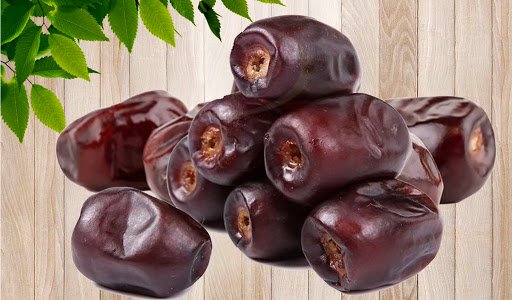
Mazafati rotab dates are Mazafati sold at the soft rutab stage. Mazafati is a dark, very soft variety with high moisture, and it comes from Bam in the Kerman province of Iran. Malaysian sellers list it as Rotab Mazafati Bam or kurma madu, and every pack sold here is imported, because Malaysia has no commercial date-growing trade. The word “rotab” on the label names a ripeness stage, and this page explains what that stage is and what it means for buying and storing the fruit.
What rotab means
Rotab is the Malaysian spelling of rutab, an Arabic ripeness term. The FAO’s date palm handbook, published by the UN’s Food and Agriculture Organization, explains that there are no equivalent English words for these stages, so the Arabic names are used internationally. It glosses rutab as “meaning wet” and also calls it the soft ripe stage.
At rutab the tip of the fruit starts to ripen first. It turns brown or black and goes soft, and the astringency of the earlier stage fades. FAO adds that, with a few exceptions, rutab fruit is very sweet. The stage is short. FAO gives it two to four weeks on the palm, and during that time the fruit keeps losing weight as it loses moisture.
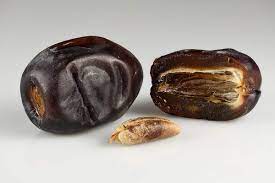
Tamar, or tamr, is the stage after that: fully ripe and drier. In FAO’s description the skin sticks to the flesh and wrinkles as the flesh shrinks. The handbook calls this final stage the best condition for storage. A pack marked rotab holds fruit at the soft stage, before that drying.
The five stages, start to finish
FAO divides date development into five stages. Dates reach the market only at the last three.
| Stage | Other names | What FAO says about the fruit | Length on the palm |
|---|---|---|---|
| Hababouk | Habbabok, Hababauk | Immature, about the size of a pea, covered by the calyx | Four to five weeks |
| Kimri | Khimri, Jimri, the green stage | Hard, apple green, not suitable for eating | Nine to fourteen weeks, the longest stage |
| Khalal | Khalaal, the colour stage | Hard ripe; turns yellow, pink, red or scarlet depending on variety; reaches full size | Three to five weeks |
| Rutab (rotab) | Routab, “meaning wet”, soft ripe stage | Tip ripens first, turns brown or black and softens; very sweet except in a few varieties | Two to four weeks |
| Tamar (tamr) | Full ripe stage | Fully ripe; skin wrinkles as the flesh shrinks; best condition for storage | Final stage |
FAO also notes that whole dates are harvested and sold at three of these stages, khalal, rutab and tamar, depending on the variety, the climate and what the market wants. Every stage except tamar is perishable because of its high water content.
Why Mazafati rotab dates are on sale in every month
Here the handbook and the Malaysian market seem to pull in different directions. FAO lists three problems with rutab fruit: it comes off the palm in fairly short bursts, it is highly perishable, and it is delicate, which makes handling and transport difficult and expensive. Unless rutab dates are cold stored, it says, they “quickly turn sour and become of no commercial value.”
For Mazafati the answer in Malaysia is cold storage. Mazafati is cold-stored and sold year-round, so rotab Mazafati is available in March as well as in October. A rotab listing in a month far from harvest is normal, and it is no reason to doubt the pack. For context, Gulf and Middle-East dates are mostly harvested from late summer to autumn, roughly August to November, and new-season stock reaches Malaysia some weeks after that.
FAO is also clear about why growers bother. It says a well-matured rutab, handled with care, is one of the most appreciated forms in which dates are eaten, if not the most appreciated, and the one that gives the grower the highest return.
What researchers have measured on Mazafati at rutab
Mazafati has been studied mainly as a crop. A PubMed search for “mazafati” on 11 November 2026 returned eight papers, and none of them looks at people eating the fruit. Three of them deal with the fruit around the rutab stage.
The first covers a problem in the orchard. Researchers at the University of Jiroft describe date bunch drying and wilting, which shows up between the Kharak (khalal) and Rutab stages and coincides with hot, dry winds. On 10-year-old Mazafati palms, covering the bunch tail with a zinc-oxide nanocomposite cut the disorder by 35% at the lower concentration and 88% at the higher one (Azimi et al., 2025).
The second weighed the fruit. In an orchard in Kerman province, palms were injected with iron, zinc or calcium, and fruit was measured at the rutab stage. Zinc at 4 g per litre gave the heaviest fruit, 17.59g (Damankeshan et al., 2026).
The third looked at the move from Rutab to a soft Tamar. Fruit from palms with a higher leaf-to-bunch ratio (2.5 to 3) had the highest sugar-to-acid ratio, firmness and anthocyanin at harvest, but lost more than 10% of its weight after 60 days in storage. Fruit from the 2 to 2.5 group lost at most 3.61%. The authors suggest the higher ratio suits the short Rutab-to-Tamar window, while the middle ratio keeps better over long storage (Alikhani-Koupaei and Khosravinejad, 2025).
Keeping Mazafati rotab dates soft at home
Mazafati needs refrigeration. FAO’s line about rutab fruit turning sour without cold storage shows why cold matters for soft dates at this stage. Make room in the fridge before the parcel arrives, and put the dates in as soon as you have checked them.
One packaging study is worth knowing about, with a caution attached. Mazafati packed in film containing 5% (by weight) silver nanoparticles kept for up to 53 days, and 4°C was the best of the four storage temperatures tested (Mousavi et al., 2015). That was experimental packaging. It does not tell you how long an ordinary retail pack will keep.
Buying Mazafati rotab dates fresh
The label has three parts to check. Rotab is the stage. Mazafati is the variety. Bam is the place, and it belongs to Mazafati. Mariami and Piarom are separate Iranian varieties, both semi-dry, with their own origins. If a listing runs two variety names together, ask which one is in the pack.
Grade letters such as A, AA, AAA and Jumbo are each importer’s own size sorting, not an international standard. Compare two offers by net weight and price per kilo instead.
When you send a quote request, name the variety, the stage you want and the net weight, and give your postcode. Demand peaks before and during Ramadan, and Hari Raya, wedding hantaran, kenduri and umrah gifts bring other peaks. A request sent a few weeks before one of those dates gives you time to compare.
Dates bought as a gift raise a different question from dates for your own fridge. For a sense of how boxed gift formats are put together, see this page of date hampers and gift boxes from one Malaysian supplier. When it was checked on 11 November 2026, its boxes and packs were Medjool, Ajwa and Mariami, and none of them was Mazafati.
Older posts on this site are filed under the Kurma Rotab category, and the newest ones are on the blog page.
Short answers
Is rotab the same as fresh?
Rotab is the soft, fresh-ripe stage of a date. Tamar is the fully ripe, drier stage that comes after it.
Why is rotab Mazafati available outside the harvest months?
Mazafati is cold-stored and sold year-round, so rotab stock in any month is normal.
Is kurma madu a different date?
No. Kurma madu is a Malaysian market name for Mazafati.
Are Mazafati and Mariami the same?
No. Both come from Iran, but they are separate varieties. Mariami is semi-dry and chewy, and Mazafati is very soft.
More about this site is on the About Us page.